

A newly published EBU Recommendation will help broadcasters to assess how well their television lighting performs. R 137, which is accompanied by a software-based analysis tool, recognizes the fact that many new LED lights don't perform as well as might be expected. While these new lights are more energy efficient than traditional tungsten lights, the benefits may be outweighed by the potential cost of colour correction during post-production.
An EBU project group on LED lights was established at the end of last year with the aim of building on pioneering work done by the BBC during the 1970s and 80s. The group has updated the Television Lighting Consistency Index (TLCI) and provided software that allows broadcasters to quickly and easily assess the performance of an individual light (or luminaire).
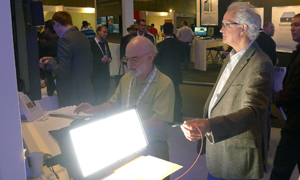
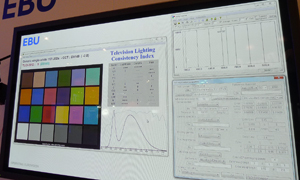
Left: Alan Roberts and Per Böhler testing a luminaire at IBC 2012; Right: A typical report from the TLCI-2012 software.
The TLCI quantifies how well a set of test colours are reproduced when illuminated with a given light and viewed through a standardized camera and TV system. The software compares the differences in colours produced by the light source under test with those produced under standard lighting conditions. It assigns a value (from 0 to 100) to each light tested, and that value provides an indication of how much colour correction would be required to produce acceptable results with that light.
In addition to the value assigned to the light, the software also provides additional information that can be used to advise colourists on how much correction is needed. In cases where the value assigned to a light is less than 50, even with a lot of colour correction the results may still be unacceptable. Such lights should probably be avoided for most productions.
The TLCI-2012 Recommendation, software and supporting documentation are available here.