

For the first time the IFA embraced not just products for the media industry but all kinds of consumer electronics, from washing machines, to laptops. IFA went brown and white for the first time this year. Two trends caught the eye in the white goods – energy saving and pollution reduction. The white goods industry is going to be a major beneficiary of higher energy prices, as the public replaces its appliances for more energy efficient ones.
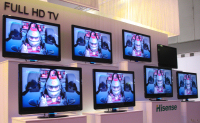
As for media products, display screens are getting larger (up to 380cm), they are getting thinner (down to 4cm), and they need ever less power. The 1080p (1080 x 1920) screen is replacing the WideXGA (768 x 1298) screen, and HDTV broadcasts (1080i or 720p) - those on show - look lower quality than 1080p Blu Ray. Will broadcasts be ‘second class HDTV’ in the future?
Higher field rates
Several manufactures showed higher field rate displays – 100Hz, 200Hz, and even 600Hz. The intermediate fields are electronically interpolated. The author stared at these products for a long time without seeing any benefit unless the object in the scene was moving very fast. Equally, the displays with 10 bits/sample showed little noticeable benefit. A more thorough look is needed to see if these are real benefits or gimmicks.
There were 3D demos from Philips and the HHI. Both used a lenticular-surfaced display and processing of a received main signal and a depth signal to create the signals for the left and right eye horizontal stripes. They were interesting, but still suffered from limited resolution and viewing angle, and seemed likely to induce eye fatigue. There is still work to do on 3DTV.
HDTV 'top up'
HHI showed an HDTV 'top up' system which broadcasts a 1080p signal as a 720p base layer and the extra to create 1080p as a separate broadcast. The combined bit rate was relatively high. The IFA (and Germany) seem rather silent about using DVB-H for broadcasting to handhelds, but HHI also showed a DVB-H IP statistical multiplex, with bitrates of 200 - 400 kbit/s per channel. The IRT was present on the ARD booth to demonstrate an HDTV system which jumps to another satellite transponder if a simulcast HDTV version is available. ARD and ZDF are expected to begin HDTV broadcasting in Feb 2010.
The UK company TVONICS showed a set top box with built in audio descriptor capability and other measures for the handicapped, and at a price only about 30% more than a 'normal' digital set top box. Finally, on show again was the cute Sony Supershot Camera, already out a year or so, which takes a picture actually when the subject smiles, by analysing the shape of his or her mouth. Can psycho-analysis by digital camera be far away?