

If you are an independent public broadcaster and 95% of your audience finds you are fulfilling your aim to offer trustworthy news and documentary programmes, if 82 percent expresses its overall trust in your organisation, and if, on top of that, 74% believes they are getting value for money from the license fee, should you be complacent? Speaking at the EBU IMPS* visit to Oslo last week, NRK's CEO Thor Gjermund Eriksen answered that question with resounding 'no'. And for good reasons. A quick look at the media landscape in Norway (and many other countries) shows pubcasters are under increasing pressure from online media. The younger generations prefers to consume their news via online rather than linear media, while global players such as Netflix, threaten to erode the market for big-budget drama and movies. According to Eriksen the answer thus must be twofold: NRK has to allocate more money to (high quality) content, to provide a Norwegian-spoken alternative to foreign drama, and it must increase its organisational flexibility, to adapt to the latest requirements from the market, such as the growing appetite for immediately available mobile content, refreshed almost 24/7.

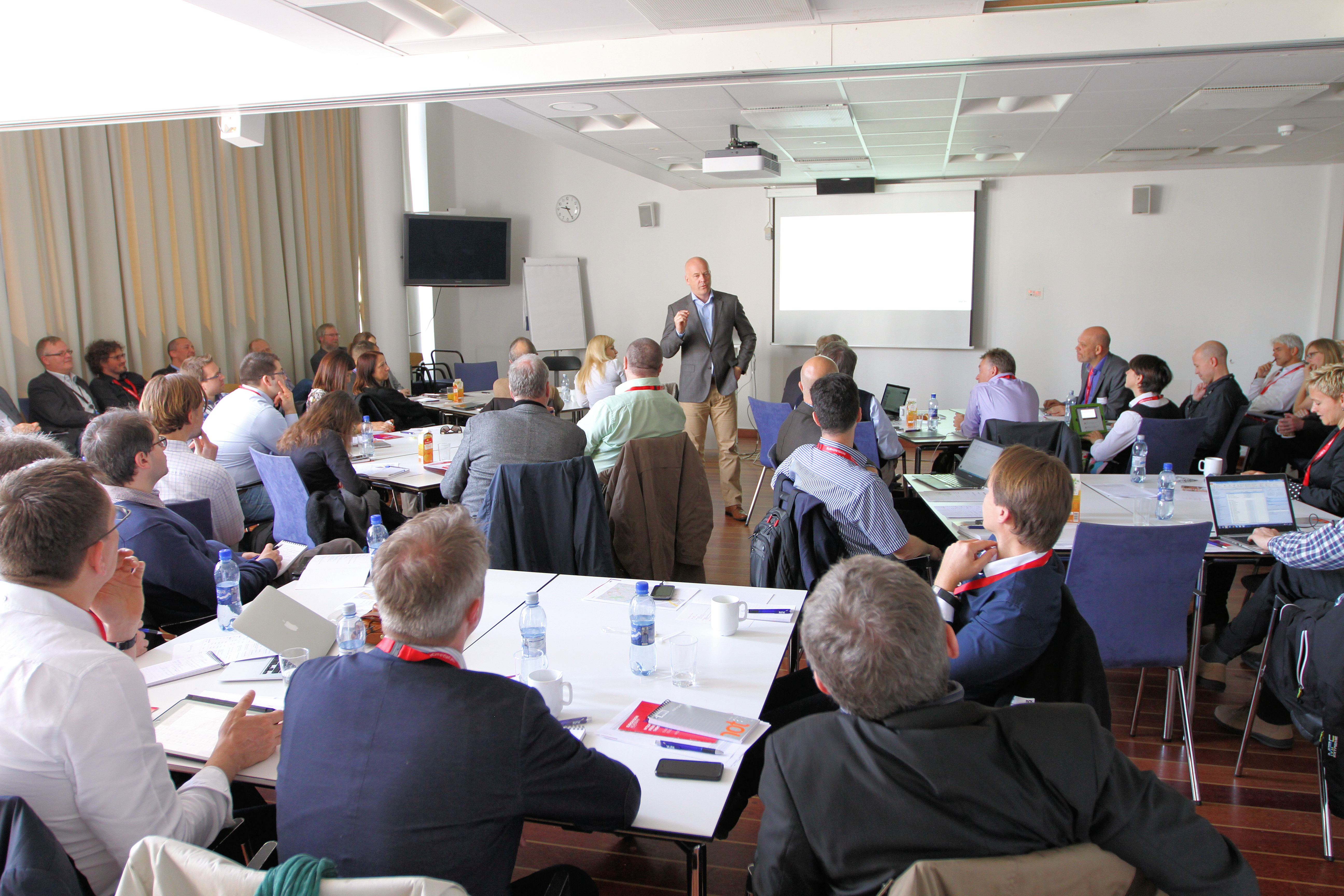
Right: Thor Gjermund Eriksen explaining NRK's strategy; Left: project manager Aksel Helgheim presenting on automated production workflows.
From a technical perspective this means making sure that all production facilities are up to the task, not only in terms of technical quality, but also in terms of speed. As NRK technical experts explained at the visit, this for example has consequences for the choice of video codecs, because it translates into requirements such as minimising the transcoding delay and avoiding vendor lock-in. As concerns the need for a more flexible production apparatus, the answers discussed in Oslo in this context revolved around more flexible system integration and the pervasive use of metadata. Interestingly, most of this is not new for NRK, which already started integrating its radio and television units back in 2002. One could argue that NRK was ahead of its time, having had the vision, but not the urgency to make such changes come through. The revolution in media technology and consumption in recent years have changed that situation and given NRK a reason to reinvent itself, even though it is already performing extremely well.
* IMPS is a cross-departmental EBU strategic programme on Integrated Media Production Strategies.