

Digital terrestrial broadcasting technology from NHK is moving towards a new generation. The prototype system, shown at NHK’s Open House day in May 2010, makes a large leap forward in the capacity of a digital terrestrial TV channel.
In Europe, DVB-T2 has been developed which extends the capacity of the TV channel by 50-60%. NHK have taken the technology one stage further. The NHK system uses a combination of two technologies to increase the data capacity of a single 6MHz broadcast channel to 60Mbit/s – over double that available today.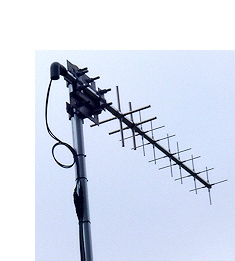
Combining two technologies for best results
The techniques are called ultra-multilevel OFDM, and Dual polarized MIMO. The Dual polarized MIMO uses both horizontal and vertical polarisations at the same time, so the receiving antenna has crossed elements and looks different (see photo on the right hand side ⇒).
The system was being use to broadcast four 14Mbit/s HDTV programmes in one 6MHz TV channel. HTV broadcasting in countries like the United States today use just one HDTV programme per 6MHz channel, so the efficiency gains could be huge if such technology forms the future.