
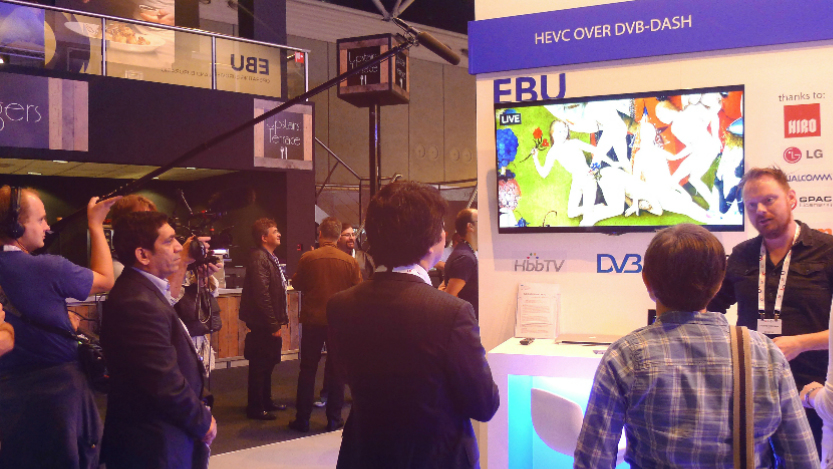
Broadband distribution is growing in importance for broadcasters. In order to improve the quality of experience and create a higher user engagement, while controlling the costs, new technologies are presented. State of the art streaming is a combination of the most advanced streaming format DVB-DASH with new High Efficiency Video Coding (HEVC) aka H.265 codec. With industry partners, we will demonstrate how this is done for both live and on demand services at IBC.
One aspect of the demo is to show how content providers can upgrade their on demand services to UHD frame sizes using H.265 (HEVC) codec in a full open source workflow. The maximum quality shown end-to-end is 3840x2160 pixel frame size at a speed of 25 full frames per seconds. The biggest advantage of H.265 or HEVC is its efficiency, as less bandwidth is needed to deliver the same quality as the most common used codec H.264. This has a positive impact on both the storage and streaming cost of the content provider and allows users to enjoy a better quality video using less internet traffic.
Another state of the art streaming solution is the encoding and end-to-end playout on both a connected TV of a live feed using HEVC and DVB-DASH. Live services require real-time encoding. The EBU demo shows that this can be done using a software based (fast) generic server. In both the live and on demand setup, MPEG-DASH is used as streaming format. One of its main features is its support of adaptive streaming. The internet bandwidth of the home gateway at the demo is artificially throttled to simulate the best effort internet. Over time, one can clearly see that the picture quality improves when there is more bandwidth available and decreases when speed drops; all without interrupting the audio and video playback. In the live setup, the players of the TV and tablet switch seamlessly between HEVC representations of 7680x432p25, 1280x720p25 and 1920x1080p25.
For the first time, this demo shows the use of the new specification DVB-DASH which is a subset of MPEG-DASH optimized for the needs of the DVB community. Officially it is called Digital Video Broadcasting (DVB); MPEG-DASH Profile for Transport of ISO BMFF Based DVB Services over IP Based Networks. DVB-DASH specifies both the on demand and live profile of MPEG-DASH and is the main candidate to be referenced again in the popular hybrid TV standard (HbbTV V2) that is expected to be published at the end of this year.
The demo uses the EBU Test Engine for Encoding to generate the on demand and live feeds. The test platform is expected to act as 'reference implementation' for creating different audio/video formats in the contribution/distribution production chain using only open source software. It is intended to facilitate the discussion about suitable MPEG-DASH content generation (including encoding and packaging settings) for different use cases. With an EBU account, one can access the created files, test and leave comments. Members of EBU, DASH-IF, DVB and HbbTV can also create files in an automated workflow that can be shared for comment. Go to EBU.IO to access the Test Engine.