
Eoghan O'Sullivan
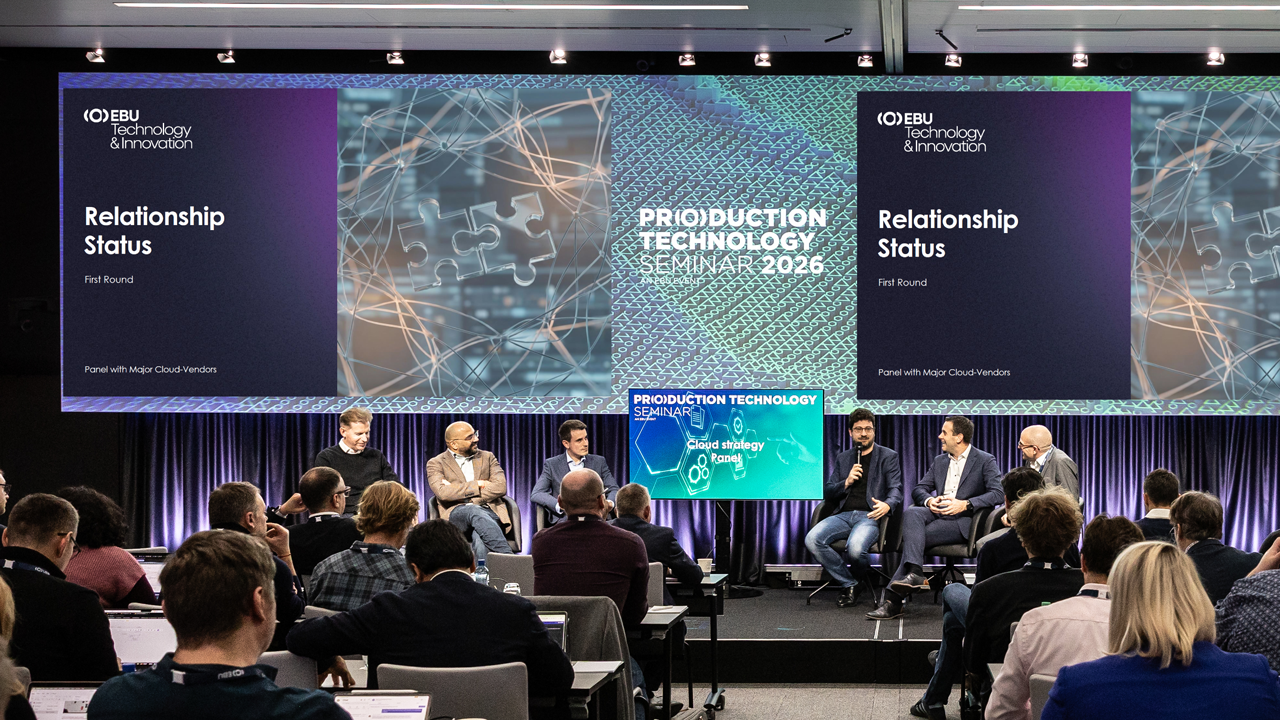
The fact that the three US-based hyperscalers – Amazon, Google and Microsoft – were separated on stage from their European counterparts, Scaleway and STACKIT, was not premeditated. Moderator Malte Blumberg later explained that a typically German desire for order had led him to arrange the speakers alphabetically. Even so, the visual division felt apt given the contours of the discussion.
The panel came after the publication of the EBU’s first Cloud Ecosystem Strategy for European Public Service Media. Malte Blumberg asked how relationships between the global hyperscalers and their smaller European counterparts were evolving. David Tulloch, representing Microsoft, spoke of the opportunity for a symbiotic relationship; Google’s Anshul Kapoor described an “open relationship”; and Steven Samwell of Amazon Web Services (AWS) said his company was “invested for the long term”.
Sovereignty concerns
Representing Paris-based Scaleway, Jean-Baptiste Kempf acknowledged that European cloud providers were late to the game, but argued that they were now running faster than anyone. Emphasizing that Scaleway focuses on compiling everything deployed on its own infrastructure, he raised three sovereignty concerns: the US legal framework allows data to be accessed without customers being informed; service cuts could leave Europe unable to run or update systems; and financial flows ultimately return to the US – or to China.
He conceded that European providers could not yet match Amazon Web Services (AWS) on reliability and quality, but said they were closing the gap. He also urged European industry to adopt a more American innovation mindset and to resist the tendency to overspecify solutions.
STACKIT’s Robin Hermann struck a less combative tone, but similarly called on European organizations to “be brave” and take the first steps with local hyperscalers. This, he argued, was the only way to break the chicken-and-egg situation and overcome the powerful “flywheel effect” already enjoyed by the US-based giants.
The US hyperscalers described measures taken to address growing demand for sovereign cloud services in Europe. Anshul Kapoor highlighted Google’s investments in Germany, including a US$ 5 billion commitment to build, in consultation with the German government, an “air-gapped” solution. Access by US-based engineers would require explicit permission, and even a US-side kill switch would not interrupt operations.
Both AWS and Microsoft pointed to extensive partnerships and support for open-source tools as evidence of their commitment to openness. David Tulloch explained that Microsoft’s strategy increasingly involves embedding its services into the tools and workflows already used by media organizations, with Azure infrastructure open to all protocols, whether proprietary or open source. Steven Samwell highlighted AWS’s role in scaling and operationalizing the BBC-developed Time Addressable Media Store (TAMS) API for storing, querying and accessing segmented media.
Leaving a cloud
Malte Blumberg put the panellists on the spot by asking who would make it easiest for customers to leave their cloud. Jean-Baptiste Kempf said that, to ensure portability, EBU Members should standardize on Kubernetes for managing containerized applications and on S3, now widely regarded as a de facto standard. He also warned that egress fees could quickly become prohibitive.
Asked for strategic advice for public media, Steven Samwell and David Tulloch both stressed the importance of leadership and of creating space for innovation: without this, organizations risk defaulting to familiar approaches. Anshul Kapoor acknowledged that sovereignty was a critical and timely challenge but said that staying relevant to audiences was an equally pressing priority for EBU Members.
If the panel revealed two distinct camps, there was clear alignment on the European side of the divide. Both Jean-Baptiste Kempf and Robin
Hermann closed by urging public media to act boldly, arguing that only decisive action would allow Europe to build credible alternatives.
This article first appeared in the March 2026 issue of tech-i magazine.
(Photo: Nathalie Mastail-Hirosawa)