
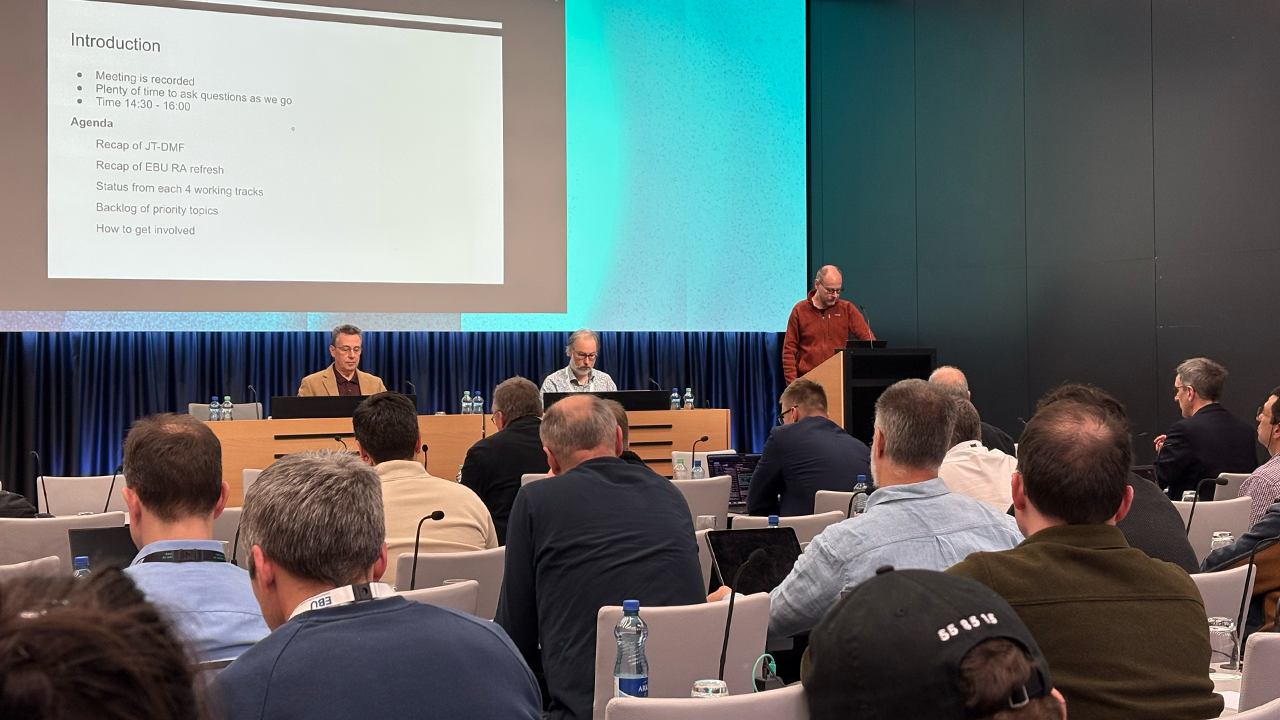
Addressing the many facets of a far-reaching technology framework such as the EBU’s Dynamic Media Facility (DMF) concept requires collaboration, and that’s what the new “Joint Task Force” JT-DMF was created to do. Run in partnership by the EBU and the Advanced Media Workflow Association (AMWA), the task force recently held its first meeting at EBU headquarters in Geneva. About 110 participants joined on site and online, representing a good cross-section of the industry, including commercial broadcasters and technology vendors.
There was a general consensus among the participants that media producers and outlets are beginning to think about a shift to software-defined, flexible and interoperable infrastructure not as an option, but a strategic priority – to better be able to respond to changing audience habits, a more complex distribution landscape, and cost pressures. DMF addresses those requirements (and also incorporates many of the values summarized by EBU’s “M.A.R.S.” strategy: "Multilayer, Anywhere, Resilient, Sustainable.")
Significantly, the JT-DMF Kick-off didn’t only focus on the nuts and bolts of software, architecture, and flow protocols. The inclusion of a business-level discussion track addressed the fact that moving to DMF will reshape not just production technology, but business models, vendor relationships, and even organizational culture.
Charting the path ahead
The first physical meeting of JT-DMF needed to set the right work in motion to ensure that DMF-compliant technology can emerge, function properly, and support a thriving technology and business ecosystem by delivering real advantages to users and vendors.
In what speakers described as a “fairly unique collaboration” of public service broadcasters, commercial players and technology suppliers, the participants then broke out into a number of working tracks to align on problem statements, strategies and roadmaps. The tracks included:
- End-to-End synchronisation model: Establishing uniform time-alignment of media essence in asynchronous, distributed DMF workflows.
- Compute resource management: Enabling multi-vendor hosting of media functions on shared compute nodes.
- MXL flow discovery & connection: Defining an architecture for how control protocols (e.g. via NMOS) discover and connect MXL flows.
- Business-level discussion: Focusing on strategic, governance and business implications of shifting to DMF.
What comes next
In the coming weeks, the tracks defined at the kick-off meeting will begin to address their tasks. With the help of their respective Chairs, each track will follow an initial timeline and meeting cadence, to define the global synchronization model, set priorities for resource management, connect MXL flows, and elaborate business and governance models.
In parallel, the JT-DMF will continue to oversee and establish integration and alignment with other relevant initiatives. The open-source MXL SDK – which already provides the core technical underpinnings for a DMF architecture – will remain central, with the aim to have newly defined capabilities added quickly. Naturally, DMF/MXL will also align with other meaningful technologies that play a role in this shift, including standards such as ST 2110, which the EBU and its partners have long championed.
In the mid- and long-term, the initiative also aims to champion and integrate relevant thought leadership and innovation that supports the transformation of how media is produced operationally: approaches that exploit the advantages of moving away from hardware silos towards cloud-native or IT-native workflows, and that are built around principles of scalability, flexibility, and resilience.
JT-DMF seeks to ensure diversity of perspectives and buy-in for a truly interoperable ecosystem. Broader industry participation is always welcome – including by end-users, system integrators, and vendors. If you’d like to know more or get involved, contact us at: [email protected] or [email protected]