
Renate Dörr, European Affairs, ZDF
Germany is one of the first countries to implement the European Union’s findability rules, which aim to ensure that content of public value remains visible and accessible in an increasingly fragmented digital media environment. These rules are part of the broader regulatory framework established by the EU’s Audiovisual Media Services Directive. In Germany, the rules (Article 7a of the AVMSD) are implemented through the Medienstaatsvertrag (Interstate Media Treaty), under the responsibility of the Landesmedienanstalten, Germany’s regulatory authorities for media.
To understand the German approach, three key questions must be answered: who are the addressees of the rules? Who are the beneficiaries? And how are the rules implemented?
The findability rules apply to two main components: media platforms and user interfaces. Media platforms are services that bundle broadcasting or online content into a single offering. Examples include cable networks, IPTV providers, and OTT platforms. User interfaces, including smart TV menus and electronic programme guides (EPGs), serve as the navigation layer for these platforms. These interfaces are crucial, as they determine how easily users can access content. A distinction is made between media platforms and media intermediaries, such as social media, app stores, and search engines. While intermediaries are not subject to findability rules, they must comply with non-discrimination principles.
Public value status
Regarding beneficiaries, one important aspect of the German model is that public value status is not limited to public broadcasters. Commercial audiovisual and audio services can also qualify if they meet legal criteria such as providing political or historical reporting, ensuring accessibility, or offering youth- oriented programming. Following an open call for proposals, over 300 services were granted public value status.
This broad inclusion, however, presents a significant challenge: how can hundreds of services be made easily findable on platforms with limited screen space? Smart TVs, app bars and remote controls offer a limited number of prominent positions.
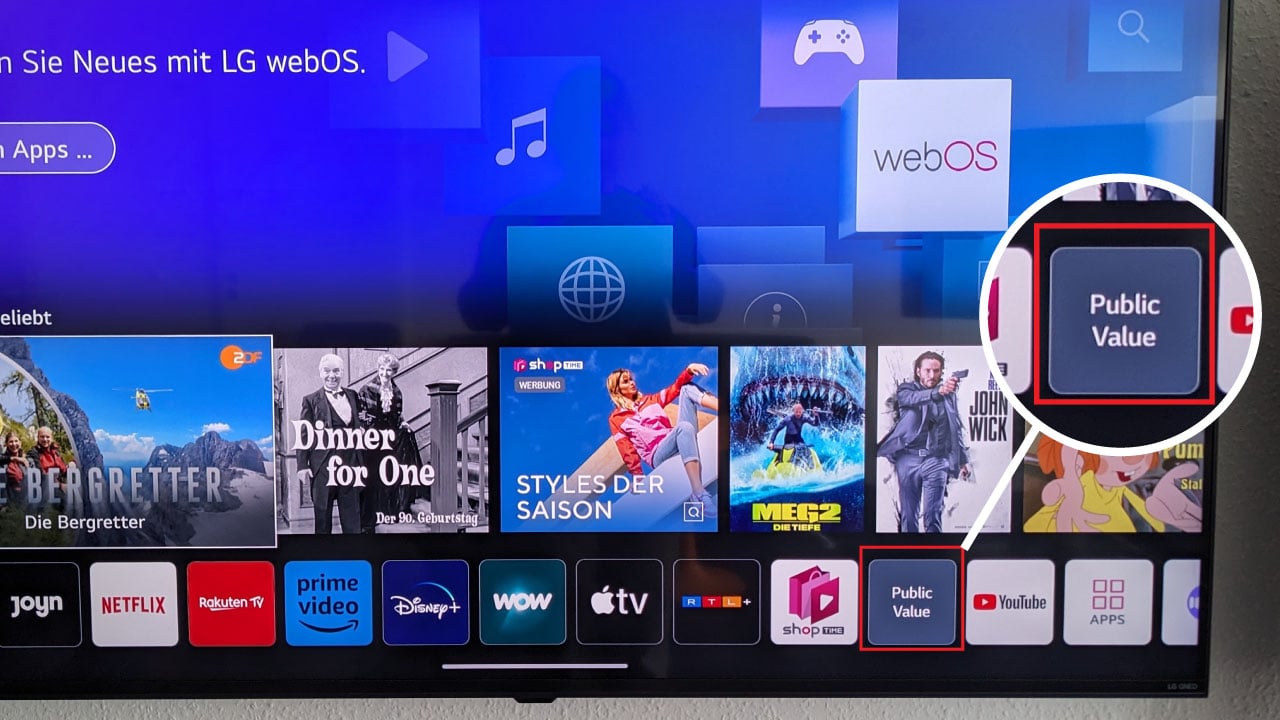
To address this, a dedicated tile on the first selection level of user interfaces was introduced (see image above). Behind this tile, users can access the apps of all public value services. While conceptually a good idea, this solution has proven ineffective in practice. It has become a kind of ‘public value container’ that is largely ignored. Audience research has shown that a very small minority of users notice the container and click on it. Moreover, the law does not regulate remote controls, which still prominently feature buttons for Netflix, Amazon, or Disney.
Another challenge is the increasing disaggregation of content. Platforms typically now highlight individual programmes rather than entire services, making it harder for users to associate content with its source. Since current rules apply only to entire services, they
fail to address this shift in user behaviour.
Lessons learned
Germany’s experience offers three key lessons:
- Limit the number of public value services to ensure meaningful visibility.
- Define privileged positions on user interfaces and remote controls to avoid relegating public value content to ‘dead zones’.
- Adapt rules to address content disaggregation, ensuring that individual programmes are also prominently displayed and linked back to their original platform.
While Germany’s effort to implement the EU rules should be welcomed, practical implementation must evolve to keep pace with technological change and user behaviour.
Future European regulations may need to go further in defining prominence rules that reflect how people actually access and engage with content today.
This article first appeared in the September 2025 issue of tech-i magazine.