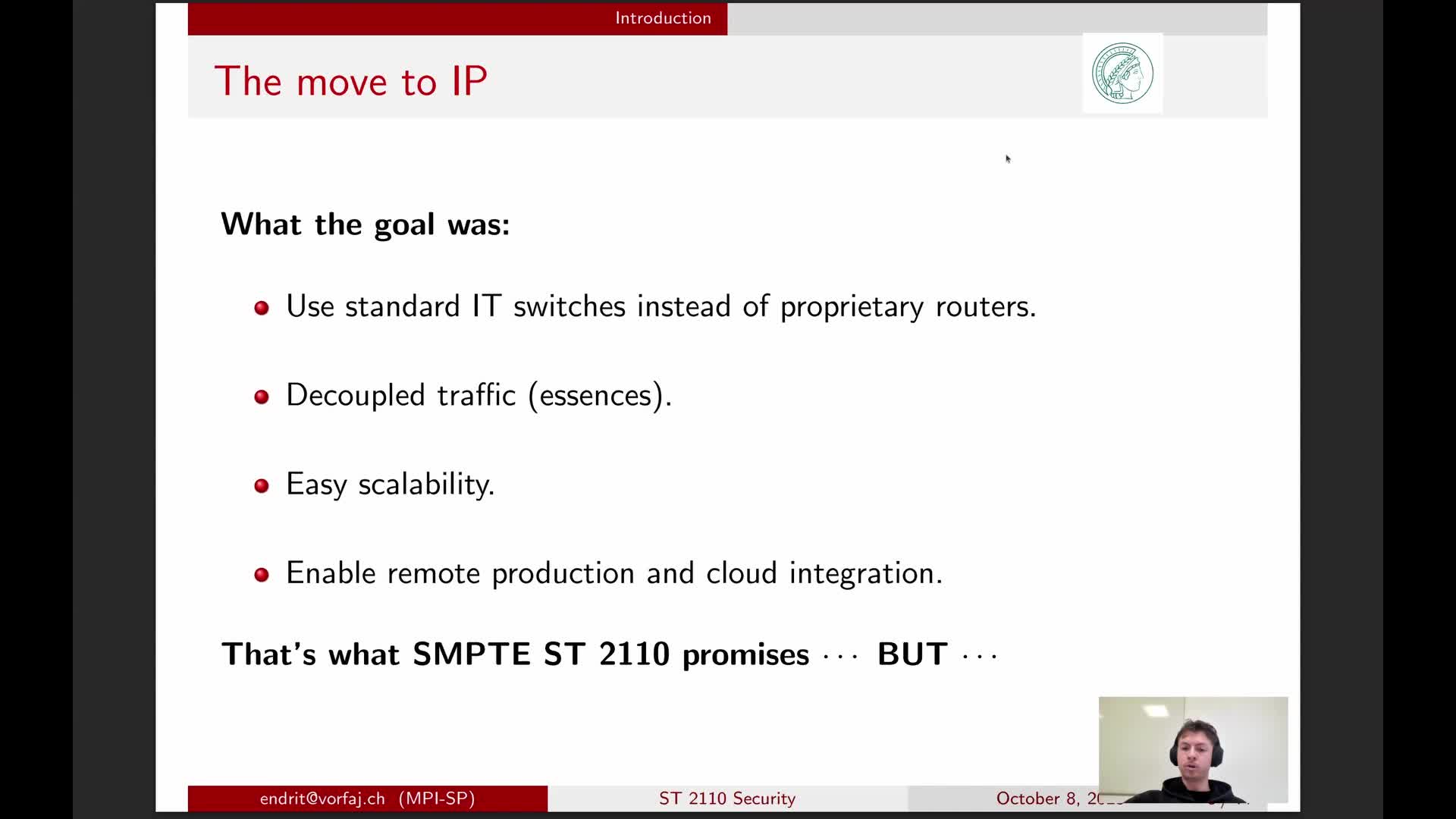
This webinar provides actionable recommendations for building secure, next-generation media facilities. Endrit Vorfaj demonstrates ways that an attacker could compromise live video and audio streams in ST 2110 networks, and evaluates effective mitigation strategies, such as network segmentation and securing the systems that manage device connections.
The industry's shift to IP-based infrastructures, such as ones based on the SMPTE ST 2110 suite of standards, brings efficiency and scalability. But it also exposes critical broadcast operations to a new range of cybersecurity vulnerabilities inherent to IP networks, including stream hijacking, data tampering, and denial-of-service attacks that can take a station off-air.
Endrit's key finding is that conventional IT security solutions often fail to meet the strict real-time performance demands of live broadcasting. Endrit shows that tailored approaches that bridge the gap between broadcast engineering and cybersecurity, including secure control protocols, can provide robust protection without introducing harmful latency.
Speaker
- Endrit Vorfaj (Security Research Assistant, Max Planck Institute)
Endrit is a fresh graduate of the joint master’s program in Cybersecurity at EPFL and ETHZ, currently working as a Security Research Assistant at the Max Planck Institute for Security and Privacy in Germany. His work builds on his Master’s thesis at EBU, where he investigated the security challenges of IP-based media facilities, with a focus on the SMPTE ST 2110 suite of standards. At MPI-SP, Endrit further develops key components, particularly around NMOS IS-10 and the application of encryption in broadcast networks.