This site is available to all users in English. EBU Members can log in to access our website in 20 additional languages as well. This innovation is powered by the EBU’s internal AI engine, EuroVox.
(Note: Translations are generated with the help of AI without human review. These translations are made available to you for convenience and may contain inaccuracies or errors. Please check important information in the original English version or contact us. The EBU cannot be held liable for any inaccuracies or errors contained in these translations.)
Last month, the EBU switched to a new authentication method, Microsoft Entra, and decommissioned the former one (sso.ebu.ch).
What this means for most EBU Members ?
Employees of most EBU Members should now use a federated login to authenticate. This means your organization acts as the identity provider. You no longer need 2 separate accounts or 2 separate passwords. Your work credentials give you access to EBU content.
What to do on the next screen ?
If you already have an EBU account, enter your professional email address and select Next. You will see the EBU logo change to your organization’s logo. Enter your usual work password and, if prompted, accept the sharing of information with the EBU.
What if we are using shared mailboxes ?
The new authentication mechanism does not work with shared mailboxes. If you usually access EBU websites using a shared account, you must create a new individual user account. Scroll down to view the instructions.
If federated login does not work ?
For some EBU Members, as well as the general public, federated login will not work. Login remains possible with your existing account. 3 different cases may occur:
Case 1: If your email address is linked to a Microsoft account, you will be redirected to https://login.live.com. Log in using your usual Microsoft credentials.
Case 2: If your email address is linked to a Google account, you will be redirected to https://accounts.google.com. Log in using your usual Google credentials.
Case 3: If your email address is not linked to either service, you will receive a temporary password by email each time you log in.
What to do if none of the above seems to work ?
Please read the instructions below carefully, as the choice you make during your first login cannot be changed later.
To create a new account, select No account? Create one.
You will have 3 options:
Microsoft: Recommended for users working for EBU Member organizations.
Google: Create an account using your existing Google account.
Other valid email address: A temporary password will be sent to your inbox each time you log in.
If you still cannot log in after following these instructions, contact [email protected].
NAB: Stereoscopic earthrise, 3D audio, and more
There was no doubt, at NAB 2009, that the most exciting demonstrations were from Japan. NHK (the national broadcaster) and the NICT (a national research institute in Japan) offered a wonderland of new media technology in a large demonstration area, which helped to lift the shadow of economics.
The highlights included a stereoscopic large screen TV presentation of material shot by the Kayuga satellite passing over the moon, of an 'earthrise' on the moon. Seeing this really brings a sense of proportion to our planetary worries. The moon appears to be just a large hunk of rock in space, and the earth warm and inviting.

"Integral TV"
NHK also demonstrated an early version of a future more elaborate 3D system without glasses, which offers a picture with some characteristics of a hologram - 'integral TV' (see photo). A SHV camera (32 Mega pixels) is used which has a large array of cylindrical lenses (140 by 120), recording an approximation of an 'object wave'. The display reverses the taking process. The results were interesting, but still low resolution.
Once more NHK offered more than specular pictures in Super High Vision. In this set were included many shots taken from above, looking down on the action. SHV has horizontal and vertical surround sound, so the sound location all over the face of the screen could be done with the vertical surround dimension.
3D Sound System
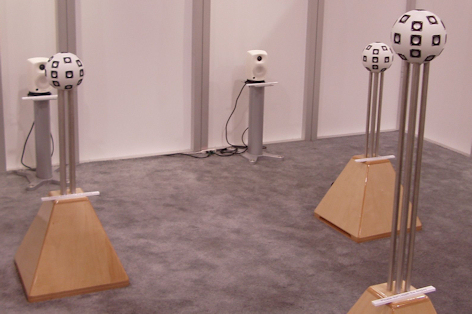
The NICT offered a range of new systems, including 4 thousand line material played off a normal PC, a fascinating device which would allow the viewer to 'blow up' any part of the screen he liked. There was also (the author's personal favourite) a home '3D sound system'. The photo shows that the sound is provided by 'mushrooms' each with about 25 sound channels and small speakers on their surfaces. These mushrooms are strategically placed in a room, and can be heard well from all directions. The result is that you really feel you are 'walking among the musicians' when you hear music. A fascinating experience, but probably a little too much for our clumsy family.
The winners of the EBU Technology & Innovation Awards 2026 will be announced during the EBU T&I Summit in Barcelona on 18 June. Here we list the nominees...
The June 2026 edition of tech-i magazine is now available for download. Covering the usual wide range of topics, there is a particular focus on sovereignty...
SVT’s Dennis Buhr describes how the 2026 Winter Olympics stress-tested the Swedish broadcaster’s transition – in both technical and organizational terms...
The EBU is committed to diversity and equality, and EBU Technology & Innovation particularly supports educational initiatives in STEM activities via the...